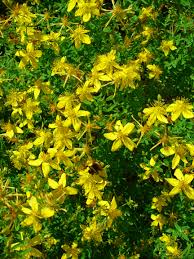
With the feast day of St. John the Baptist tomorrow (June 24th), I thought it would be a perfect time to talk about St. John’s wort (Hypericum perforatum). This plant became popular in the 1990s after it was featured in the mainstream news as a remedy for depression and anxiety. As a result, this is what it’s mostly known for now, yet it is useful for so much more than that. It originally comes from Europe and has a long history of use for the nervous system, the liver, nerve pain, immunity, burns, and trauma to the skin. It can be found along roadsides, meadows, and open woodland. If you look at it close enough, you can see the small dots on the leaf, an important distinguishing feature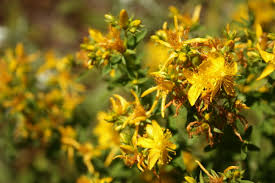 . It has a fairly pleasant taste, similar to black tea.
My favorite way to use it is in an oil, where I mentioned in a different post that it turns into a deep red color when infused in the sun. The best time to pick the flowers for this purpose is after a few days of sunny weather when the buds have not quite fully opened. If you press a bud in between your fingers, you will notice a purple stain, indicating it is ready to be picked. Cut the top part of the plant and stuff into a clean, dry jar then top with a good quality olive oil and place in a sunny spot for 2-4 weeks. You will notice the oil turn red, which I have not seen any other plant do. After the time is up, you can strain the oil through a cheesecloth, re-bottle, and use as needed. It can be used externally for sciatica, nerve pain, bruising, and burns. However, you shouldn’t apply it before going out into the sun, as some people found it can irritate the skin.
The tincture can be used internally for sciatica as well, or any other issues resulting from nerve pain. Shingles, for example, can also be helped by St. John’s wort. You would use a standard dose- approximately 2 dropperfuls 3 times per day. For both sciatica and shingles, one can use the tincture internally and the oil externally at the same time. You should start feeling relief after a few days and continue use for up to a week or so. The same goes for carpal tunnel syndrome. The only caution with using St. John’s internally is if you are taking prescribed medication. Because St. John’s helps to remove toxins from the liver fairly quickly, it has to be used with caution when taken with certain medications. It acts by accelerating their clearance from the system, faster than they would normally break down, so if you are taking medications that need to be in your system at a certain dose, you should avoid taking this plant. Otherwise, it is great at helping the liver detox and can be taken if one suspects they may have liver congestion due to years of poor eating and lifestyle habits.
Regarding anxiety/depression, there have been different explanations for why this herb is useful. Some theorize it works well because it helps the liver, and when your liver is working well, there is less systemic inflammation and you will feel better overall. Others say one of its constituents, hypericin, increases the metabolism of serotonin and melatonin, and another constituent called hyperforin slows the uptake of certain neurotransmitters like dopamine, allowing them to circulate in the body longer. It does need to be used over a period time for it to work in this way. There are many factors to consider with anxiety/depression though, and I wouldn’t use just one plant. Folks have also used it for seasonal affective disorder.
Try to get out there and find this plant. If you don’t know what it looks like, consult a good field guide or one of the books in the resources section.
 A Spoonful of Garlic
Leave a comment