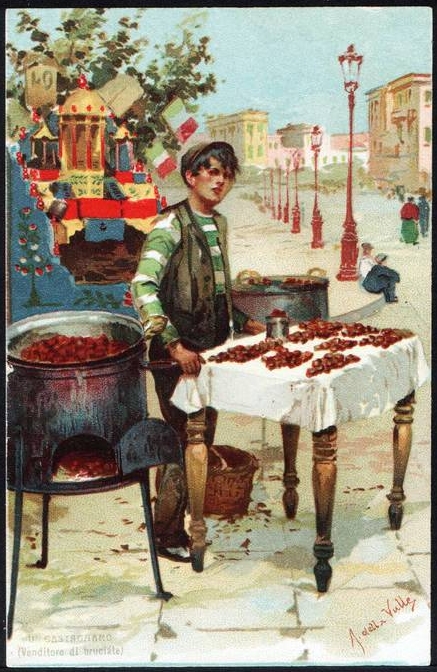
Chestnuts just don’t get the attention they deserve anymore, except for the reference in the famous Christmas song. It’s too bad, since the American chestnut tree (Castanea dentata) was one of the most abundant and useful trees in the eastern United States. This once gargantuan tree kept humans and wildlife well-fed for thousands of years, and its wood was used in almost every aspect of life. Its range stretched from Maine to Georgia and westward into Tennessee and Ohio. Sadly, a blight that was first noticed in 1904 in New York quickly decimated approximately 4 billion trees in the first part of the 20th century. The pathogen originated in Asia and was unknowingly brought to this continent, called Cryphonectria parasitica, which the American chestnut was no match for. This blight was considered to be one of the worst ecological disasters in North America- not only because it left this particular species of chestnut on the brink of extinction but because the wildlife and communities that have relied it for so long suffered as a result.
If you grew up eating roasted chestnuts every autumn like I did, you can imagine how tragic this blight would have been to individuals who grew up in Appalachia at that time- the region that was most associated with the chestnut. To give you an idea of how many nuts these trees produced, a single tree could produce thousands of them. Forests were said to be knee-deep in fall crop. The tasty and nutritious brown nuts are actually wrapped inside a burr, and one burr can contain 3 nuts:


Mountain folks had to beat the hogs to them in the fall! Harvest time was October, and the nuts could last throughout the winter on forest floors, ensuring a food supply for bears, rabbits, deer, squirrels, raccoons, wild turkeys, and pigeons. After the blight, there was a decline in certain animal populations. Chestnuts were also used to barter for goods by mountain farmers and be used as currency; that’s how prized they were. Unlike acorns, whose crop was not always reliable, chestnuts bloomed in summertime when any chance of frost was gone. There was an abundant and reliable crop year after year. The wood was also extremely versatile, being lighter than other hardwoods, cheaper to ship, and containing a high amount of tannic acid that defied rot. The wood was used to make desks, beams, tables, pianos, fence wood, rails, shingles, cabins, barns, and coffins. There are other species of chestnuts such as the European and Chinese varieties that provided sustenance for people in those regions. The Chinese chestnut trees are immune to the pathogen that caused the blight, while the European trees were subject to the disease but were not devastated like the American variety.
If you’ve never tried chestnuts you’re in for a treat! Apparently they can be eaten raw, but they taste best roasted in the oven (or perhaps on an open fire) because it brings out their natural sweetness . They come out this time of year and are usually from Italy. According to Girolami Farms, chestnuts are a high energy food and contain vitamin C, potassium, calcium, phosphorous, and other minerals. You have to cut them before roasting so you’re able peel the hard outer layer and thin inner shell when they are done. Take a sharp knife and cut an X on each side of the nuts *carefully*. Like so:
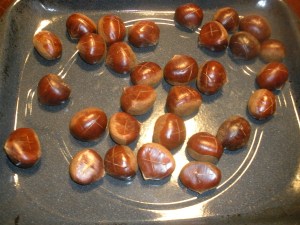
It’s best to hold the nut down with one hand then score it with the other, so as not to cut yourself (speaking from experience). Place in a 400 degree oven for about 25 minutes or until the edges are curled outward and the shell peels easily from the inner flesh. As soon as they’re cool enough to handle but still warm, peel them and enjoy. They get harder to peel when they cool. They taste sweet and delicious. I found out some people boiled them, which may be fine but definitely give them a try roasted first. They can be made into soups, purees, souffles, added to stuffing, etc.


Currently, The American Chestnut Foundation is working to restore the American chestnut in the U.S by using a back cross method that breeds trees resistant to the blight. It’s a long process but hopefully it will be successful and this amazing tree can finally be restored. If you feel so inclined, you can even get involved!
 A Spoonful of Garlic
Leave a comment